
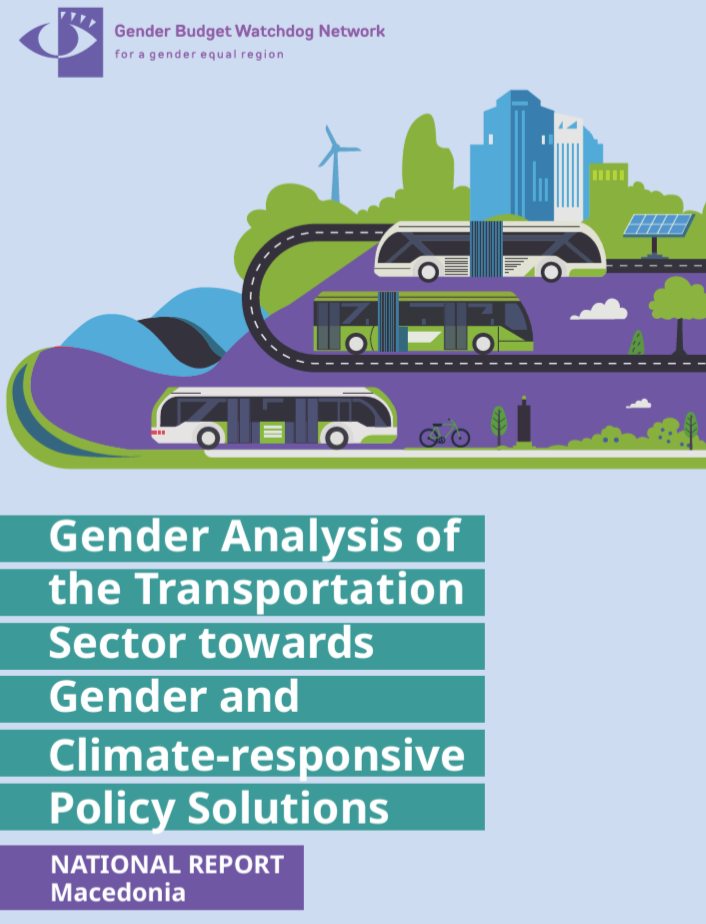
The Center for Research and Policy Making (CRPM), a lead partner of the Gender Budget Watchdog Network (GBWN), has released a national report on transport and gender, revealing significant gender disparities and the urgent need for gender- and climate-responsive transport policies in North Macedonia.
Based on an online survey of 1,100 citizens, focus groups in Skopje and Ohrid, questionnaires with public transport users, and an in-depth policy analysis, the study reveals sharp gender gaps in mobility access and highlights the environmental challenges of the country’s transport sector.
Key Findings: Significant Gender Gaps in Mobility
- Transport choices: Men are far more likely to own cars and bicycles, while women disproportionately rely on buses as their main mode of transport.
- Nearly 80% of those without access to a car or bicycle are women.
- Affordability barriers: Women rely more on cheaper public buses, while men more often consider private cars and taxis as “affordable” options.
- Preferred modes of transport: Women primarily choose buses (70.8%), while men report greater access to cars (54.63%).
- Car ownership: Out of the 65.3% of respondents who declared owning a car, 59.2% are men and 40.8% are women.
- Bicycle ownership: Among the 38.7% of respondents who own a bicycle, 64.1% are men compared to 35.9% women.
- No car or bicycle ownership: 22.6% of respondents reported not owning either a car or a bicycle. Of this group, 79.5% are women and only 20.5% are men.
- Accessibility: Both men and women identify cars (76.5%) and buses as the most accessible forms of transport, while e-bicycles (3.5%) remain the least accessible.
- Urban vs. rural differences: People in urban areas own more cars compared to those in rural areas.
- No access to any type of transport: 4.5% of respondents reported having no access to any type of transport. Out of the 50 respondents in this category, 20% are women and 30% are men.
Safety Concerns Affect Women’s Mobility
Women’s access to transport is limited not only by affordability but also by safety concerns, particularly in rural areas:
- 66.1% feel unsafe cycling,
- 55% walking,
- 37.5% taking a taxi,
- and 37.1% feel unsafe using public buses at night.
“Women are the majority of public transport users, yet their needs remain overlooked in transport planning. At the same time, the transport sector is a major driver of air pollution and climate change. Without inclusive and green reforms, North Macedonia risks deepening inequalities and missing its sustainability goals,” says Marija Risteska, CRPM Executive Directress.
Recommendations for Action
The report calls for urgent measures to ensure inclusive and sustainable transport:
- Integrating gender-responsive budgeting into transport and climate policies.
- Allocating specific budget lines to meet women’s and vulnerable groups’ mobility needs.
- Investing in affordable, safe, and sustainable bus transport and expanding cycling infrastructure.
- Collecting regular sex-disaggregated mobility data to inform policy.
- Strengthening institutional cooperation to ensure inclusive, climate-friendly transport systems.
Investing in Equitable and Green Transport
Findings from Skopje and Ohrid highlight the urgent need for safer, more inclusive, and climate-friendly transport. Women, who make up the majority of bus users, report feeling safer on buses than they do when walking—underscoring the importance of investing in better bus infrastructure and services.
- Ohrid: More inclusive subsidies, expanded bicycle infrastructure, and improved facilities for electric vehicles.
- Skopje: Stronger infrastructure maintenance, integration of vulnerable groups, and better cooperation between city and municipalities, alongside a new Rulebook for cycling development.
Additionally, equally important is to engage the City’s Coordinator for Equal Opportunities at every stage of planning, budgeting, and evaluation to translate policy into meaningful, inclusive outcomes.
The report provides concrete cost estimates for measures such as subsidies for bicycles and child seats in Ohrid, and infrastructure upgrades in Skopje, showing that equitable and green transport investments are both feasible and urgent.
Read the full report: “Gender Analysis of the Transportation Sector towards Gender and Climate-Responsive Policy Solutions”