Deutsche Gesellschaft für Internationale Zusammenarbeit (GIZ) GmbH and the private partner Bovin Winery, in cooperation with the Center for Research and Policy Making (CRPM), are implementing the project ” Development of an organic waste management in grapes and wine production in Tikveš region”, which is financially supported by the Federal Ministry for Economic Cooperation and Development of Germany (BMZ).
The project is within the framework of the CRPM Sustainable Development Program, sub-program for the development of a circular economy. Within the framework of the project, a circular business models were developed and piloted, including sharing, processing, reusing and recycling of bio-waste in the long term.
The goal of the project is to create and establish an efficient and sustainable model for bio-waste management (utilization) from wine and grape production in Macedonia. This project engage big and family wineries from the Tikvesh region, local authorities from Demir Kapija, Kavadarci and Negotino, PUCs, several higher education institutions, line ministries, civil society organizations and associations working in the field of ecology and the wine industry.
Project duration:March 2022 – February 2025
Financed by: European Commission – INTERREG EUROPE Programme.
Final beneficiaries:
Target groups:
Ministry of Finance;
Ministry of Economy;
Ministry of Agriculture, Forestry and Water Economy;
Ministry of Environment and Physical Planning;
State Inspectorate for Environment;
Inspection sector in the framework of the Food and Veterinary Agency;
Municipalitiy of Negotino;
Municipality if Kavadarci
Municipality if Demir Kapija;
National Federation of Farmers;
Faculty of Agricultural Sciences and Food;
Faculty of Technology & Metallurgy;
NGOs and wine associations;
Other relevant public institutions.
Revision of the legal and strategic framework for bio-waste management from wine and grape production and promotion of multilevel dialogue.
Development of a comprehensive analysis of the current practices and development of sustainable bio-waste utilization business model (s).
Pilot and disseminate the developed business model(s) for bio-waste treatment with at least 10 wineries.
Raising the awareness among practitioners via verification of the sustainability of the developed model
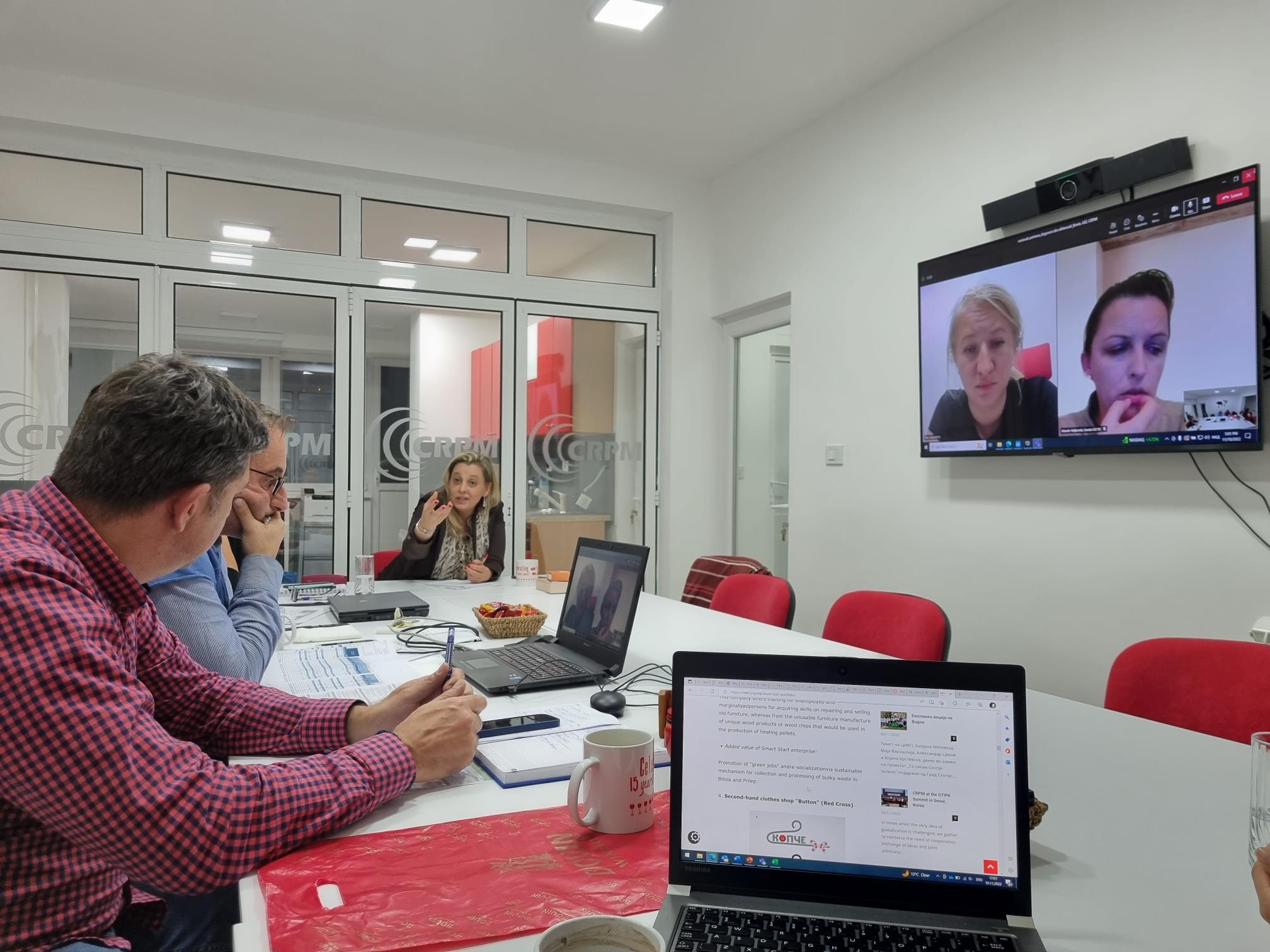
At the very beginning of the project implementation, the project team mapped the relevant stakeholders regarding to the utilization of organic waste from wine yards in ecologically acceptable manner. We established a work group (WG) that is serving as a platform for dialogue and exchange, aiming for identifying the challenges, gaps and possible solutions for introducing the circularity practices in the Tikves region. The working group is consisted of 20 members, from the MAFWE, MOEPP, MOLSG, MOE, targeted municipalities (Kavadarci, Negotino and Demir Kapija), PUs, Chamber of Commerce, National Farmer Federation, Vines of Macedonia, our project team members and experts. Several meetings were held with the working group, tackling the existing polices at national and local level, available capacities for bio-waste utilisation and possible changes for greater engagement of the stakeholders to improve the current bio-waste management practices. The group contributed in the development of the GAP ANALYSIS OF THE LEGAL AND POLICY FRAMEWORK – DETERMINING NEEDS FOR DEEVLOPMENT OF CIRCULAR ECONOMY MODEL IN TIKVESH REGION.
Team of experts were engaged to analyse the current situation along with the quantities and composition of generated bio-waste from vineyards and agriculture in general in the Tikves region. The analysis encompasses most of the by-products and waste generated in production including grape pomace, lees, seeds, stalk and dewatered sludge. The experts provided data on the available raw materials as the potential for their treatment, recycling and recovery solutions. The Analysis of organic waste generated from the wine production and potentials for treatment in Macedonian vineyards and wineries in Tikveš region, with focus on Bovin winery.
Four business models were developed for the production of pellets, briquettes, oil and seed flour, and natural fertilizer. For each model, two scenarios were created: one using old equipment and another with new equipment. Additionally, a Public-Private Partnership (PPP) scenario was developed specifically for the production of briquettes. The technological processes were outlined, along with 10-year forecasts for each business model. To support dissemination efforts, a business teaser was created each business model to effectively communicate the potential of these initiatives
The first Peer-Review visit that we attended was held in Bohinj, Slovenia (DATE), where our Slovenian partners show-case the Human-Wildlife-Conflict polices and practices, that can be transferred in Macedonia as well, knowing the fact that our current HWC polices are not effective. PICS
The second Peer-Review visit, was organized in Vidzeme Region, Latvia, (DATE) where our Latvian partners show-cased the citizens science practices and citizens participation in policy shaping, regarding the biodiversity and environmental protection. PICS
After every peer visit, the organizer develops a study visit report on expert recommendations and adaptable solutions to be disseminated with the local stakeholders.
The wine production industry generates significant bio-waste, with approximately 40% of this waste being burned in the soil, contributing to greenhouse gas emissions (such as methane, dinitrogen monoxide, carbon monoxide, and nitrogen dioxide) and heat release into the atmosphere, thereby causing environmental harm. Utilizing this bio-waste to create value-added products is essential for wineries globally, contributing to environmental protection, economic development, and enhancing social status. Currently, there is no dedicated bio-waste treatment system, and PUCs do not manage or collect the bio-waste from vineyards or wine production. To address this gap, we aimed to identify viable solutions that could be applied across three municipalities, potentially involving public-private partnerships (PPP).
During 2023 in our search for solutions, we partnered with the UNDP office in Skopje, which was launching the first bio-hack laboratory in the city. They invited us to participate in the piloting phase, where two experts from the Faculty of Technical Sciences (prof. Jana Klopcevska and prof. Vesna Rafajlovska) developed Minimum Viable Products (MVPs) from the vine branches of the Bovin winery: a natural fertilizer and pellets. These MVPs formed the foundation for developing business models focused on converting viticulture and wine production bio-waste into products such as briquettes, pellets, natural fertilizers, oil, and flour.
THE PILOT
Step 1: The initial process involves collecting and measuring the calorimetric value of the briquettes. We found that the briquettes had a calorimetric value of 17,000 J/gr, making them comparable to firewood in terms of energy content.
Step 2: Proper collection of the vine branches post-pruning was critical. We used a balling machine at Bovin Vineyards to gather the branches and stored them outdoors to ensure they dried properly.
Step 3: Transportation of the dried biomass to the production plant followed, where the collected material would be processed into briquettes.
Step 4: The production process took place at a local start-up briquette plant in the region – Makkaus. The biomass was chopped, mixed, and pressed into high-quality briquettes.
Step 5: Once the briquettes were produced, we launched a promotional campaign in the target municipalities—Kavadarci, Negotino, and Demir Kapija—emphasizing their economic viability, environmental benefits, and social impact.
Step 6: The Mayor of Kavadarci agreed to pilot the use of the briquettes in one elementary school to test their environmental impact. Two tons of briquettes were procured and used for heating in the school, with emissions compared to firewood. A team from Goce Delcev University, lead by the dean prof. Dejan Mirakovski, conducted the measurements, and the preliminary data was promising. It showed a 30% reduction in PM10 particles compared to firewood, demonstrating a significant environmental benefit.
Step 7: With these positive environmental results and demonstrated economic viability, the local public schools, which traditionally use firewood for heating, became the first official consumers of the new briquette product, paving the way for broader adoption.
Through this pilot, we have not only demonstrated the potential of wine production bio-waste as a valuable resource but also created a sustainable solution with significant environmental, economic, and social benefits.
During 2023 in our search for solutions, we partnered with the UNDP office in Skopje, which was launching the first bio-hack laboratory in the city. They invited us to participate in the piloting phase, where two experts from the Faculty of Technical Sciences (prof. Jana Klopcevska and prof. Vesna Rafajlovska) developed Minimum Viable Products (MVPs) from the vine branches of the Bovin winery: a natural fertilizer and pellets. These MVPs formed the foundation for developing business models focused on converting viticulture and wine production bio-waste into products such as briquettes, pellets, natural fertilizers, oil, and flour.
The document covers the following topics:
To disseminate the findings from the technical and economic assessments and share the successfully piloted model, the project team organized three training workshops in Demir Kapija (04.06.2024), Negotino (12.06.2024), and Kavadarci (24.06.2024). These workshops were designed to build local and regional capacities regarding bio-waste treatment solutions. A total of 55 participants attended, including vineyard and winery owners (business sector), PUCs, and national and local officials. The workshops introduced the concepts of circular economy and sustainable waste management practices, highlighting their importance in the context of wine production bio-waste.
The workshops also emphasized the critical role of stakeholder collaboration in enhancing the efficiency of waste collection and processing. To foster cooperation and commitment, Statements of Interest were introduced, and 16 vineyard and winery owners signed these agreements, expressing their intent to participate in future bio-waste management initiatives. This collaborative approach will play a key role in advancing sustainable waste practices and supporting the long-term success of the project.
FINAL CONFERENCE
On 18th November, 2024, wthin the framework of the European Week for Waste Reduction, the final conference was organized: Sustainability in grape and wine production in the Tikvesh Region.
The aim of the conference was to promote the integration of circular economy principles in the wine production process in the Tikvesh Region, focusing on the reduction and reuse of bio-waste, as well as sustainability and quality standards in wine production, with an emphasis on geographical indications.
The conference provided a platform for discussion among eminent stakeholders, including scientists, experts, government representatives, business leaders and professional associations. Two panel discussions were held in the first part of the event, and the second part was a mini-fair where products from (bio)waste from grape and wine production and other circular innovative solutions were presented. In parallel, participants had the opportunity to enjoy a tasting of our local wines and connect with circular business ideas.
During 2023 in our search for solutions, we partnered with the UNDP office in Skopje, which was launching the first bio-hack laboratory in the city. They invited us to participate in the piloting phase, where two experts from the Faculty of Technical Sciences (prof. Jana Klopcevska and prof. Vesna Rafajlovska) developed Minimum Viable Products (MVPs) from the vine branches of the Bovin winery: a natural fertilizer and pellets. These MVPs formed the foundation for developing business models focused on converting viticulture and wine production bio-waste into products such as briquettes, pellets, natural fertilizers, oil, and flour.
THE PILOT
Step 1: The initial process involves collecting and measuring the calorimetric value of the briquettes. We found that the briquettes had a calorimetric value of 17,000 J/gr, making them comparable to firewood in terms of energy content.
Step 2: Proper collection of the vine branches post-pruning was critical. We used a balling machine at Bovin Vineyards to gather the branches and stored them outdoors to ensure they dried properly.
Step 3: Transportation of the dried biomass to the production plant followed, where the collected material would be processed into briquettes.
Step 4: The production process took place at a local start-up briquette plant in the region – Makkaus. The biomass was chopped, mixed, and pressed into high-quality briquettes.
Step 5: Once the briquettes were produced, we launched a promotional campaign in the target municipalities—Kavadarci, Negotino, and Demir Kapija—emphasizing their economic viability, environmental benefits, and social impact.
Step 6: The Mayor of Kavadarci agreed to pilot the use of the briquettes in one elementary school to test their environmental impact. Two tons of briquettes were procured and used for heating in the school, with emissions compared to firewood. A team from Goce Delcev University, lead by the dean prof. Dejan Mirakovski, conducted the measurements, and the preliminary data was promising. It showed a 30% reduction in PM10 particles compared to firewood, demonstrating a significant environmental benefit.
Step 7: With these positive environmental results and demonstrated economic viability, the local public schools, which traditionally use firewood for heating, became the first official consumers of the new briquette product, paving the way for broader adoption.
Through this pilot, we have not only demonstrated the potential of wine production bio-waste as a valuable resource but also created a sustainable solution with significant environmental, economic, and social benefits.